Princeton Meal Exchange
A platform that allows students to swap meal swipes between different dining venues.
Introduction
Princeton has a unique assortment of dining venues. In addition to the dining halls, there are eating clubs, which are essentially social houses with a dining hall built into it for upperclassmen who choose to join them. This causes a problem: how do you eat with friends who aren’t in the same eating club or dining hall plan? The solution: meal exchange! The University announced that they will discontinue the platform in Spring 2026. This sent the eating clubs and the students who rely on it into a period of uncertainity about what the future of meal exchange will be like, but also presented an opportunity for us to make something radically better.
Unexpected Responsbility
Because of scheduling and time zone difference, we made little progress in the beginning of the summer. In the beginning of July, it was looking like this project might not be able to launch on time. We had tasks assigned, but everyone was making progress at different pace, sometimes blocking another task. Some members also dropped out because of other responsbilities. The problem I discovered was that we are working in a corporate-like style, when our team size and time constrain does not allow us to do that. We don’t have the flexibility to do peer-review on every PR, nor do we have enough people to be breaking a task into multiple sub-issues. I proposed that remove the functional boundary, and just focus on getting it done. I went from only developing the accept invite feature, to redesigning the entire UI, communicating with the University to get SSO working and dining plan data exchange going. It worked. We launched the platform (somewhat) on time, and our stakeholders quite like the new platform!
Afterwords
To this day, we still continue to add new features based on feature requests we get, and what we feel it needs. One of the developer felt that there weren’t enough observability so he added a super cool activity dashboard!
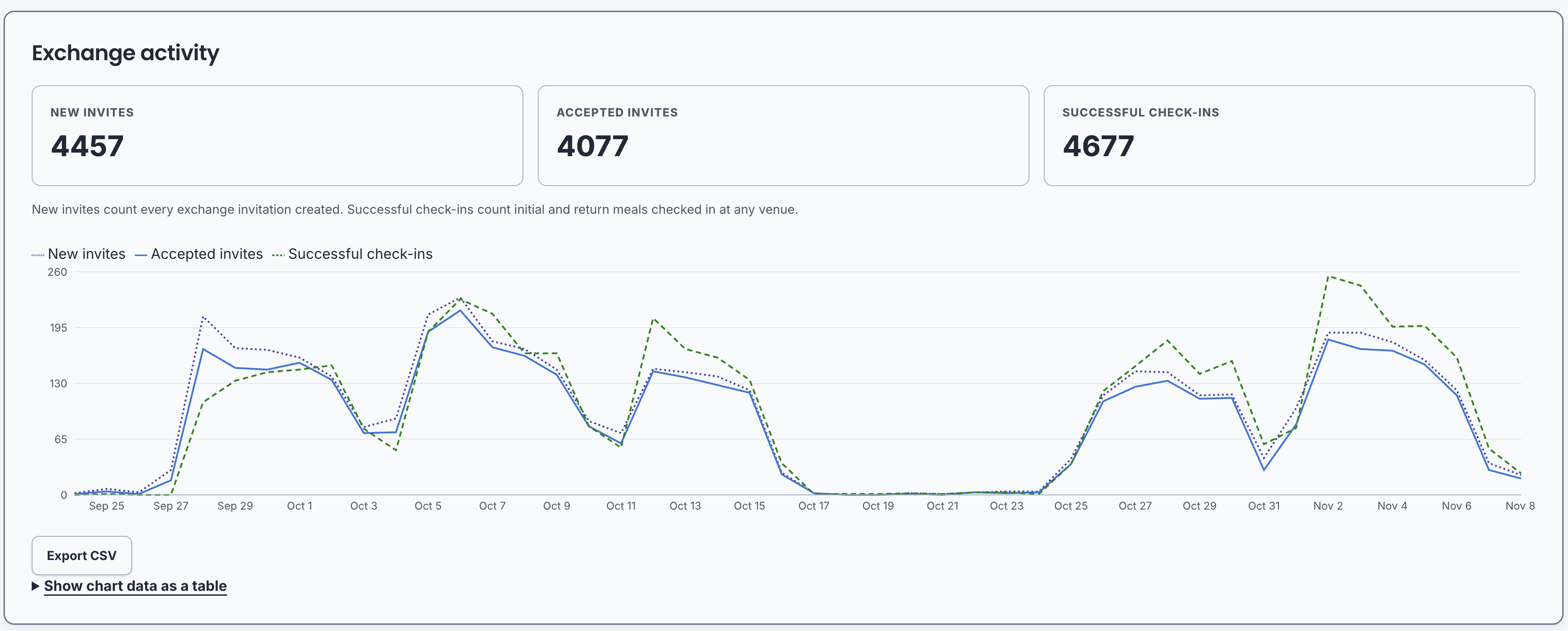
Cumulatively, we have handled over 4600 exchanges (which is nearly $100k in monetary value if you price each meal around 20 dollars)! Our site handles peak lunch and dinner traffic quite well, and it was built to be easily vertically scalable.
Please visit about to learn more about the project, and team to learn more about the amazing team I worked with to make this happen!
Infrastructure (for those interested)
Our rationale for tech stack is to be able to iterate quickly, using technologies our team are all mostly familiar with.
Backend
- The application was written in Next.js. Using better-auth to integrate with the University’s Microsoft Entra ID Single Sign On (SSO) system, and drizzle as ORM.
- We use PostgreSQL as our primary DB, with Point in Time Recovery and periodic volume backup.
- The application and its associated services are hosted on Railway.
- We use Resend as our primary email delivery service.
Frontend
- Our frontend is built with mobile experience in mind, so all viewports and interfaces scales and adjusts accordingly in smaller screen width.
- We use playwright and vitest to provide end to end coverage of our interfaces.
Compliance
- Our application complies with WCAG 2.2 AA accessbility standards.
- We also worked with the University’s Office of Information Technology to conduct Architecture and System Review.